From Forest Floors to Frequency: A Field Recording Primer for Ambient Producers
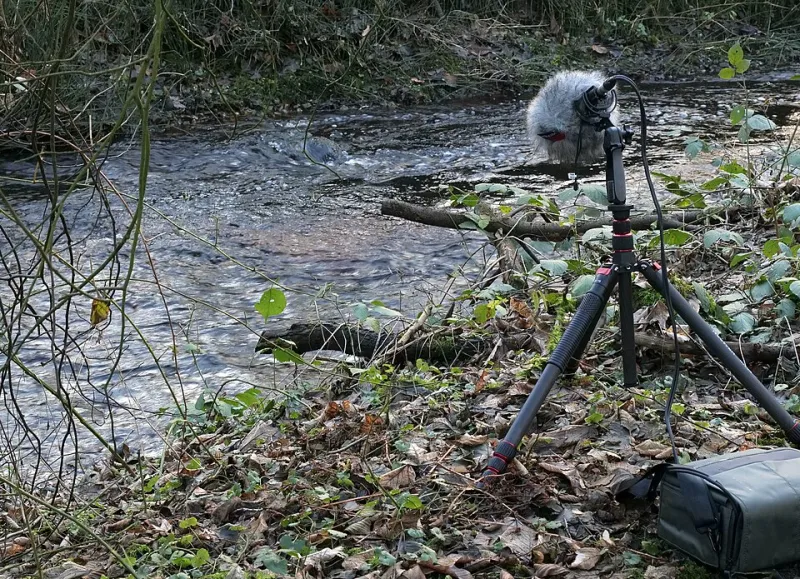
Photo: ChristianSW, CC0, via Wikimedia Commons
There's a moment every field recordist knows well. You're standing completely still — maybe in a pine forest outside Asheville, maybe on a Chicago rooftop at dusk — headphones on, boom mic extended, holding your breath. And then you hear it: the exact sound you've been chasing. A low rumble of distant thunder. The wet percussion of rain on a tin roof. The metallic groan of a suspension bridge in wind.
For ambient producers, that moment is everything. Field recording — the practice of capturing environmental audio in real-world settings — has quietly become one of the most powerful tools in the electronic music toolkit. And across the US, a growing community of sound designers and ambient artists are heading out into the wild (and the not-so-wild) to find the raw material for compositions that feel genuinely atmospheric.
We caught up with a handful of these producers to get the full picture: the gear, the workflow, and the creative philosophy behind turning a thunderstorm into something you can loop at 60 BPM.
Why Field Recordings Hit Different
Synthesizers are incredible. But there's something about organic audio that no plugin can fully replicate — a kind of unpredictability, a texture with microscopic imperfections that the human ear instinctively registers as real. When you layer a processed field recording beneath a pad or a drone, it grounds the listener in a way that pure synthesis rarely does.
"I think people feel it even when they don't know what they're hearing," says Marcus Delray, a Portland-based ambient producer who releases under the name Stillwater Margin. "I'll take a recording of a river and pitch-shift it down three octaves, run it through a reverb tail, and suddenly it sounds like something breathing. People tell me my music feels alive. That's why."
This approach — treating environmental sounds as raw sonic clay — sits at the heart of what producers call musique concrète in its classical form, but modern ambient artists have pushed it into entirely new territory.
The Gear You Actually Need (And What to Skip)
You don't need to spend $3,000 to get started. Here's what the producers we spoke to actually use in the field:
Entry-level: The Zoom H5 or Tascam DR-40X are solid handheld recorders that punch well above their price point. Pair either one with a decent windscreen and you've got a capable setup for under $250 total.
Mid-range: The Sound Devices MixPre-3 II is a favorite among serious hobbyists and semi-professionals. It offers low-noise preamps and 32-bit float recording, which gives you enormous flexibility in post.
Microphones: For stereo ambience, an ORTF configuration using small-diaphragm condensers (like the Rode NT5 pair) captures a wide, natural soundstage. For more focused, directional recordings — a specific bird call, a specific machine hum — a short shotgun mic like the Sennheiser MKH 416 is the industry standard.
"Honestly, I started with a Zoom H1n and a pair of in-ear binaural mics," admits Elena Voss, who produces ambient electronic music under the alias Pale Meridian from her home base in Santa Fe. "Some of my favorite recordings came from that little thing. The gear matters less than your ears and your patience."
Where to Record: America's Sonic Landscape
The United States is an embarrassingly rich source of diverse acoustic environments. Here are some categories worth exploring:
Natural environments: National forests, coastal wetlands, high desert plateaus, and Great Lakes shorelines all offer dramatically different acoustic signatures. The Sonoran Desert at night sounds nothing like the Pacific Northwest rainforest at dawn — and both are extraordinary.
Urban textures: Don't overlook the city. Subway stations, parking structures, construction sites, and industrial waterfronts generate complex, layered audio that transforms beautifully when processed. New York, Detroit, and Houston each have their own sonic fingerprint.
Transitional spaces: Some of the most interesting recordings happen in between — rest stops on the interstate, the mechanical rooms of old buildings, the edges of airports. These liminal environments have a natural strangeness that translates well to ambient composition.
The Production Workflow: From Raw Audio to Finished Texture
Captured your recordings? Here's a simplified version of how working producers move from raw files to usable musical elements:
1. Edit and clean. Import into your DAW (Ableton Live and Logic Pro are the most popular choices in this community). Trim dead space, reduce any handling noise, and do a light pass with noise reduction if needed. iZotope RX is the gold standard here.
2. Pitch-shift for character. This is where things get interesting. Dropping a recording down 12–24 semitones can turn birdsong into something that sounds like whale calls. Pitching rain up can create shimmering, glass-like textures. Experiment wildly.
3. Time-stretch for drones. Apps like PaulStretch (free) or Ableton's own Complex Pro warp mode can stretch a two-second recording into a 30-minute drone. This technique is foundational to a lot of contemporary ambient production.
4. Layer and blend. Stack multiple processed recordings — a stretched thunderclap beneath a pitch-shifted forest ambience, for example — and adjust levels until they feel like one cohesive environment rather than separate elements.
5. Add synthesis sparingly. A single sustained pad or a slow LFO-modulated bass note can anchor your field recordings harmonically without overwhelming them. Less is almost always more.
"I treat the field recordings like the emotional center of the track," says Delray. "The synths are just scaffolding. The real music is already in the recording — you're just revealing it."
A Few Things Nobody Tells You
Field recording has a learning curve that goes beyond the technical. Wind noise will ruin more recordings than anything else — invest in a proper blimp windscreen before anything. Always record longer than you think you need; the best moments often happen in the last 30 seconds when you've stopped paying close attention. And get permission before recording on private property or in certain protected natural areas — the rules vary by state and location.
Most importantly, slow down. The instinct when you arrive somewhere is to immediately hit record. Resist it. Sit with the environment for ten or fifteen minutes first. Let it settle around you. You'll hear things you would have missed otherwise.
The sounds are already out there, drifting across every ridge and rooftop in America. All you have to do is show up and listen.