Stop Collecting Demos: How Ambient Producers Actually Get Albums Across the Finish Line
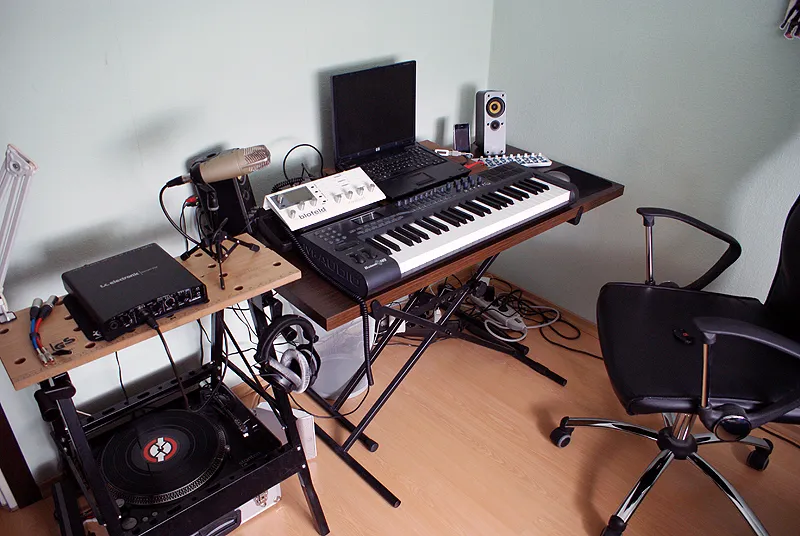
Photo: LiquidMolly, CC BY-SA 2.0, via Wikimedia Commons
Let's be honest about something: the ambient producer's hard drive is one of the most haunted places in music.
There's the 47-minute drone piece that was definitely going somewhere. The generative patch that ran for three hours and produced maybe six usable minutes. The field recording layered with synthesizer that felt transcendent in the moment and somehow completely flat the next morning. And then there are the actual albums — the ones that exist as concepts, as track lists scrawled in notebooks, as collections of stems that never quite cohered into something releasable.
If this sounds familiar, you're not alone, and you're not broken. Finishing ambient music is a legitimately different problem than finishing other kinds of music, and the gap between a promising demo and a completed album has derailed more serious producers than most people want to admit.
Here's what actually helps.
Why Ambient Music Is Uniquely Hard to Finish
The obvious answer is length. When you're working on a track that might run 20, 40, or 60 minutes, the scope of the project is genuinely daunting in a way that a three-minute pop song isn't. But length is actually the smaller problem.
The deeper issue is that ambient music doesn't have the structural scaffolding that most other genres rely on. There's no verse-chorus-verse to tell you where you are in the composition. There's no lyrical narrative pulling the listener (and the creator) through. There's no obvious moment where the song "ends" — just a gradual sense that maybe you've gone far enough, or maybe you haven't gone far enough, or maybe you should add one more layer, or maybe that layer is ruining everything.
This structural ambiguity is, of course, a huge part of what makes ambient music so compelling to make and to listen to. But it also creates what psychologists who study creative work sometimes call decision paralysis — a state where the absence of clear constraints makes every choice feel equally valid and equally questionable, which makes it very hard to commit to any choice at all.
Add to this the particular brand of perfectionism that ambient producers tend to develop — a sensitivity to texture and atmosphere that makes every imperfection feel glaring — and you have a recipe for tracks that live in the "in progress" folder forever.
The Constraint Paradox
Here's the counterintuitive thing that most productive ambient producers figure out eventually: freedom doesn't help you finish. Constraints do.
This isn't a new idea in creative work generally, but it applies to ambient production with unusual force. When the canvas is potentially infinite and the rules are self-imposed, the producers who actually complete records are almost always the ones who've built some kind of artificial structure to work within.
That structure looks different for different people. Some producers set strict time limits — a track is whatever it is after two sessions, period. Others work with hardware limitations deliberately, using a setup that physically can't generate more than a certain number of simultaneous layers. Some set a rule that every track on an album must be built from the same source material, or recorded in the same room, or processed through the same signal chain. The specific constraint matters less than the fact that it exists.
What constraints do, psychologically, is convert an open-ended creative problem into a bounded one. And bounded problems are dramatically easier for human brains to solve. Research on creative cognition consistently shows that working within limits tends to produce more original output than working without them — partly because limitations force you to make choices rather than defer them indefinitely.
Working With Your Attention Span, Not Against It
Another thing that derails ambient albums: the way attention works during long-form composition.
When you're deep in a 45-minute piece, your relationship to the material changes over the course of a single session in ways that can seriously distort your judgment. The opening section that sounded beautiful two hours ago might feel boring by the time you're working on the ending — not because it got worse, but because you've been listening to it for two hours. The layer you added in hour three might feel essential right now and completely unnecessary tomorrow morning.
Producers who finish albums tend to build systems for managing this. Some keep detailed session notes that capture what felt right in the moment, so they can revisit those decisions with fresh ears. Others work in short sessions rather than marathon ones, deliberately stepping away before their perception of the material gets too warped by overexposure. A few producers record voice memos while they work — not about the music itself, but about how the music is making them feel — so they can access that emotional data later when the analytical brain has taken over.
The underlying principle here is treating your attention as a resource to be managed rather than an obstacle to be pushed through. Ambient music asks a lot of your listening attention, and making ambient music asks even more of it. Respecting those limits isn't a weakness — it's a workflow strategy.
The "Good Enough" Problem (And Why It's Actually a Different Problem)
Perfectionism gets blamed for a lot of unfinished ambient albums, and it's a real factor. But it's worth being specific about what kind of perfectionism actually stalls projects.
For most ambient producers, the issue isn't a belief that the work needs to be perfect before it can be released — it's an inability to define what "done" even means. Without a conventional song structure to tell you when you've reached the end, "done" is genuinely ambiguous. And ambiguity is where perfectionism loves to set up camp.
The most practical solution to this is embarrassingly simple: decide what "done" means before you start, not after. Set an intention for the track or album that's specific enough to be evaluated. "This piece should feel like the twenty minutes before a thunderstorm" is a testable criterion. "This piece should be good" is not.
This kind of intentionality also helps with the related problem of scope creep — the tendency for ambient projects to accumulate layers and sections and ideas until they've become something entirely different from what you set out to make. When you have a clear original intention, you have a way to evaluate whether a new idea serves the work or just serves your anxiety about whether the work is interesting enough.
Getting It Out the Door
A few more things that actually work, pulled from conversations with producers who have managed to ship records:
Set a release date before the album is finished. This sounds backwards, but having an external deadline — even a self-imposed one — does something to the brain that internal motivation alone can't replicate. Some producers go further and tell people about the date, creating social accountability that makes it harder to keep pushing.
Separate creation from curation. Many productive ambient producers keep these phases completely distinct. Creation mode means making sounds and capturing ideas without judgment. Curation mode means evaluating what you've made and deciding what belongs on the record. Mixing these two modes — creating while simultaneously editing — is one of the most reliable ways to kill momentum.
Accept that the album you finish is not the album you imagined. This one is hard. The gap between the record you hear in your head and the record that actually exists will always be real. The producers who finish albums are generally the ones who've made peace with that gap — who understand that a completed, imperfect record is infinitely more valuable than a perfect record that doesn't exist.
The ambient music that moves people, that gets passed around and returned to and written about years later, didn't come from producers who had everything figured out before they started. It came from producers who figured out how to keep going anyway. That's the skill worth developing.